Wednesday, February 26, 2025

TA Day 4 - Dargaville to Karapai

 74 miles, 3054’ climbing

Lodging:  Parakai Geothermal Motel

Weather:  Sunny and hot


There were at least 16 tents for TA riders at the Dargaville camp site, and most of the people planned to catch the ferry at Poutu Point today. About half were getting up as we packed our tent and made breakfast. Last night was the perfect temperature for sleeping. We pedaled out in the cool air with the sun rising on our left, and misty fog over the fields and water. 


The route was paved at first, then a gravel road. The gravel roads have been well maintained but with a loose surface of gravel at times, very dusty when cars pass. We saw wild turkeys in some of the fields, and we leapfrogged with several other riders as we rode over the hills.


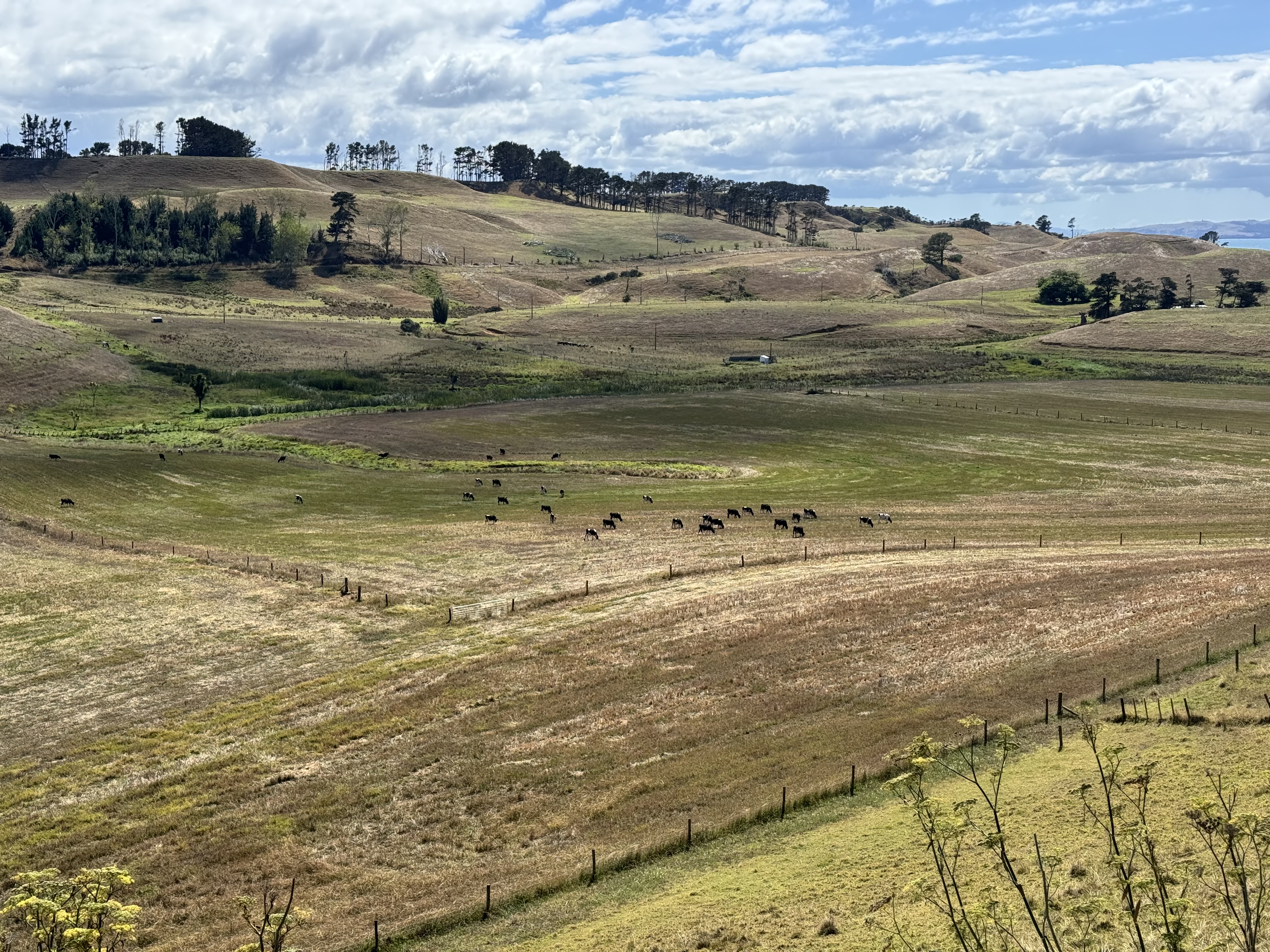
The landscape is beautiful, but it’s less wild and far more cleared of natural trees than we expected. Of course there’s still so much to see.


By 12:30 the day was heating up and we arrived at Poutu Point. The ferry wasn’t due until 5, so we spent several hours at a small community center, cleaned drive trains, had a soda and ice cream, walked on the beach. 


When the ferry arrived, it nosed straight up onto the sand. The ferry operators are experienced at transporting riders, and organized us into a brigade to pass our unloaded bikes onto the ferry for the journey. It was then 3 hours across the large Kaipara Harbor to Parakai and another 30 minutes to unload the bikes.


Since we were arriving in the dark, we booked a hotel near the landing site, a small hotel with geothermal baths. The road to Auckland is known to be dangerous during morning rush hour due to no shoulder and commuter traffic into Auckland. A bunch of people planned to ride in at night to avoid commuter traffic, and some debated the value of an alternate road. For us, that’s a matter for tomorrow. We reached our hotel around 9pm, met with Andy (Sidney Australia) and Nuttert (Netherlands) for dinner, then enjoyed a mineral soak before bed. It was a long day, but a great one for camaraderie since we had time with so many other TA riders (~65 cyclists on the ferry).



Monday, February 24, 2025

TA Day 3 - Omapere to Dargaville

 51.5 miles, 4377’ elevation gain 

Lodging:  Tent site at Dargaville Holiday Park

Weather:  Sunny and hot


When you’re at sea level, you can pretty much expect to start your ride with a climb, but the first steep hill out of town was a tough wake up call. We had a coffee and breakfast sandwich at the local cafe, then started our hilly ride south. After about a dozen miles we entered the shady Kauri Forest of tall trees, tall ferns, dense vegetation, and the persistent sounds of birds and insects that we’ve heard everywhere but along the beach. We stopped to see Tane Marita, the largest Kauri tree, after carefully disinfecting our shoes. The tree is 2000-2500 years old. Only 3% of the kauri forest is left after it was clear cut in the 1950s. 


We then had a long descent thru the cool shady forest, then back to the hot and humid hills, farm country on gravel roads and a rail trail. A road worker topped up our water bottles when our expected refill spot was closed, wishing us that our uphills be like our downhills. A young woman met us and asked to ride along. It turned out that she and her two brothers were trail angels, offering cold slices of melon and ice water to TA riders. She introduced us to their two horses and told us that we were on the last hill before Dargaville.


In town, we took a camp site at the holiday park with several other cyclists. It’s sunny and warm, and showers and laundry are welcome. Tomorrow we need to make it to Poutu Point by 5pm to get the ferry we booked to Helensville, and were told not to underestimate the ride though mileage isn’t too long.


From the holiday park, we walked into Dargaville with Quintin, the school teacher, and met a few other cyclists, for dinner and a beer. It was longer than we anticipated, but good dinner. We bought food for tomorrow at Woolworth’s a popular NZ grocery store and headed back to the holiday park to finish laundry. There are quite a few more cyclists here now, and it’s finally cooling off.


Some bits of knowledge gathered along the way…a defunct microwave is a suitable mailbox for more than one rural property owner.  Also a possum has virtually no evasive measures from autos as sadly their carcasses litter the road.


TA Day 2 - Apihara to Omapere

 57 miles, 4751 ‘

Lodging:  The Sands Hotel, Omapere

Weather:  Sunny and hot


We had coffee and a quick bite, then left the Apihara Holiday Park around 8am. Today we turned inland and rode through the hills with lots of ups and downs past rural farms. It was humid and very green with large trees and ferns at times. We are starting to see which other riders are on the same pace as us.  After about 20 miles, about 10 of us stopped for meat pies, cold drinks, and hot coffee in the tiny town of Broadwood. After a ride over some hills on gravel, about a dozen of us regrouped for the two o’clock ferry to Rawene. We decided to have an ice cream and a Coke from the market while most of the others stopped at a cafe. 


As we turned back to the coast, we had headwinds again, sometimes blocked by hills. Riding into Omapere, we saw people rowing longish boats off shore. Behind them was an island that looks like a huge sand dune.


Tonight we are staying at The Sands Hotel, a somewhat upscale establishment for this tiny town.  There is a nice restaurant with amazing views of the water.  We enjoyed a nice dinner with a glass of wine in the patio. A relaxing way to end the day.


Sunday, February 23, 2025

TA Day 1 - Cape Reinga to Apihara

 56.9 miles, 2283’

Lodging:  Apihara Holiday Park cabin

Weather:  Sunny and hot

We woke early and packed up, heading up the steep road to the cape Reinga lighthouse. Leaving our bikes, we walked out to the lighthouse at the northern tip of New Zealand, captured the requisite photos, and chatted with other brevet riders. After a short briefing, we were off down the hilly road on our way to 90 mile beach.


When we hit the stream bed next to the sand dunes, it felt surprising. We took a few photos and continued down to the beach which had a lot of surf. There was a head wind and a marine layer keeping us cool, but we made reasonably good time down the coast. After a while, it became clear that 50 miles of beach riding in a headwind was going to be a challenge. Besides the ~60 cyclists in the brevet, we saw people who drove their cars down to fish or recreate.


By mid day the winds were increasing. Cyclists were really spread out. For a while we hopped on an echelon and rode with a German couple among others, but soon we were on our own in the headwind, passing the occasional cyclist. By the time we reached Apihara, we were beat. Fortunately we got there before the tide rolled all the way in and stranded us. The sand blowning towards us looked like fog from a machine, covering the ground in swirls.


Apihara is pretty and small, and we welcomed the chance to clean our drive chains, shower, and do laundry. Many people had arrived there ahead of us, and many after. Our « cabin » was very hot in the sun, so we opened all the doors and windows, heading down to the common area.


Market options were extremely limited, and there were no restaurants, but the local bait and tackle shop was selling fish and chips. The meal was enormous, wrapped in several layers of newspaper, forming a mound the size of a throw pillow. Ed balanced it on his handlebars to bring it back to the holiday park, and it made a good dinner.


Tour Aotearoa - the Journey to the Start

 Our journey to the start of the Tour Aotearoa  brevet included 3 flights, a shuttle, and a short bike ride. Because flight times changed after we booked them, we had longish layovers, but this helped us adjust to the time zone and make sure none our bags went astray. It was comforting to have apple air tags on our bikes so we could see that they appeared to be on our planes.


Ed made wheels for our bike boxes to roll on as he did last summer, and while the boxes came off a couple times over cracks and bumps, they were great for moving thru the airport, between terminals, thru long lines in customs. We carried the wheels in our carry-on during flights and tossed them when we arrived in Kerikeri and assembled our bikes.


New Zealand customs was very particular. We had to open our bike boxes to inspect for dirt on the bikes (washed well before packing)  with specific questions about the tires. They also took our tent to a lab for quick testing, checked a freeze-dried meal that contained meat. Other travelers had their hiking boots inspected. It was impressive how much care the kiwis take to keep pests out of their country.


Our airport hotel (Heartland) was comfortable and had good food. We will be riding past it on our route in about a week. We had a long day free, so we ubered downtown to spend time outdoors and see the city. Auckland seems very cosmopolitan though a lot of restaurants appeared to be shuttered. We saw the harbor and some public art with lots of references to the Māori culture. The trees and bushes look very lush in contrast to the Sonoran desert. 


For the domestic flight from Auckland to Kerikeri, we didn’t need to show ID or go thru security. On arrival, however, Sarah’s bike box had been opened, frame bag unzipped, tire pump (formerly in the frame bag) was loose in the box, and the frame was scratched. We assembled our bikes outside the airport paying NZ$5 for the cardboard disposal. Another brevet rider, Mark Bradley from Wellington, was doing the same. We followed him into town to the local bike shop where we aired up tires and got chain lube and air cartridges. There are two days for the grand depart of the brevet, based on low tides so we can go down 90 mile beach on the firm sand. Mark departs on Saturday and we are on Sunday.


Kerikeri is beautiful and green, looking like a resort town. Our hotel had a swimming pool and green lawns. We had a swim, dinner, and bought groceries for the next two days. Our driver, Talz, picked us up Saturday morning. We took the front wheel off each bike and managed to get them both in her car. Much of landscape looks like it could be the west coast of the US but with large exotic trees and drivers on the other side of the road. We stopped once for a break on a beach, and after ~3 hours we made it to Tapotupotu camp site. It will be a big climb up to the lighthouse for the departure in the morning. 


There were 2 other cyclists when we arrived just after noon, but the campground filled with more cyclists and campers. The cove was gorgeous with a small wave break and one person out surfing. It was very windy, hard to cook, and doubtless tough for the day 1 brevet riders. 


Talz pointed out Tea Trees to us, the same ones used for Tea Tree Oil in cosmetics in the states. She said the wood is used to heat rocks and cook hangi, literally « food in the ground ». Meat is wrapped in tin foil with potatoes and sweet potatoes and cooked in the ground for hours. If we see a sign for hangi we must try it.


Monday, January 27, 2025

Up Next - 2025 Tour Aotearoa!

Billed as New Zealand’s 3000km (1864 mile) bikepacking odyssey, it is designed to showcase New Zealand roads, trails and landmarks.  While anyone is free to ride the route at any time, each February there is a brevet starting on two consecutive days and limited to 100 riders each day.  A brevet is a type of cycling event that is not considered a race, but rather a tour that must be completed within a time limit.  For Tour Aotearoa the time limit is 45 days.  The route stretches from the northernmost point in New Zealand at Cape Reinga and goes all the way to the southern end of the country at Bluff with varied surfaces and conditions including several ferry crossings.


A grand depart for a self supported bike event is a super fun opportunity to meet other cyclists with the exact same interest. You can compare plans, compare bikes and gear, see who is traveling lean and mean (no tent or sleep system?) or who is heavily laden (huge panniers, a chair?). Those on race pace will quickly disappear in the distance at the start while those riding at party pace move a little slower. We expect that within a few days we will find a few people on our same pace, and we may see them every few days throughout the tour. The first departure day will be out before we arrive, so we will mainly be mingling with day 2 people at the start.


Surfaces


Getting to the start from Tucson is a bit of a journey including 3 different flights, a couple shuttles, and a short bike ride, so it will be a bit of an adventure in itself. 


New Zealand’s summer is December to February and we will be starting on the second day of the Tour brevet on Sunday Feb, 23.  Temperatures for summer and autumn range from upper 40’s for lows to mid 70’s for highs with some areas dipping to freezing for lows later in the trip.


For more information there is a website dedicated to the event http://www.touraotearoa.nz/p/home.html and an official tracker https://app.maprogress.com/home/dashboard that operates year round for all riders.


We plan to complete the route in roughly 30 days at an average of about 62 miles per day.  To complete the brevet and show that you followed the whole route there are 30 landmarks you are required to photograph such as the northernmost lighthouse, the swinging bridge, and a glacier, but some are less stringent, for instance take a picture of cows.


We will be taking our gravel bikes and camping gear but there will be opportunities for lodging along the way as well.  We will make blog entries as internet access allows, but we won’t have connectivity the entire route.  We are looking forward to seeing the flora, mountains, coasts and rivers, all so different from where we live. We are also excited to meet the people, both brevet cyclists and locals.


The route


Thursday, August 1, 2024

Canada Bikepacking Summary - Jasper to Bellingham

Our ride through Alberta, BC, and Washington was fantastic. We’d love to go back and do the ride on the Great Northern Bikepacking Route from Princeton to Squamish another time (we skipped it due to a heat wave, and cut through Vancouver instead). Here are some of the highs, lows, and statistics of our trip:


Ride Numbers

Total days: 41

Rest days: 6 (3 due to Ed getting injured)

Miles travelled: 1716

Total Elevation gain: 92244’

Longest ride:  Day 19 - 80.3 miles

Shortest ride: Day 22 - 8.3 (Ed got hurt)

Average: 49 miles per day

Most climbing in a day: Day 7 - 4600’

Least climbing in a day: Day 20 - 240’

Days with rain: 12

Days with snow: 3

Number of Ferry Rides: 10


Overnights

Camping: 15 nights

Hotel: 23 nights

Hostel: 3 nights


Best Breakfasts

Mel’s in Elkhorn

Full Circle Cafe in Nelson


Best wildlife experiences

* Seeing two wolves in Alberta, near Banff and in the Peter Lougheed Provincial park

* A grouse hen, protecting her chicks, circling Ed while flapping her wings and tail

* A trio of bumbling black bear cubs in Port Coquitlam (mama bear ignored us)

* Seeing a dozen or more bald eagles by the old Cumberland dump


Most infuriating wildlife

Raven that stole 2 Clif bars off Ed’s bike along the Ice Fields parkway


Most overpriced meal

The charcuterie we ordered in a Victoria wine bar that turned out to be a cereal bowl of potato chips layered with a couple thin slices of cheese and salami. Perhaps we should have been more wary of a place called “Tourist”


Most fun singletrack (There was a lot of fun singletrack though some was hard on fully packed gravel bikes).

* High Rockies trail

* Elk Valley Trail segment from Koko Claims to Elkford

* Trails circling Courtenay on Vancouver Island after we arrived on the ferry to Comox — so much shady, winding singletrack that day!


Best swims (only when the weather turned warm):

* Horne Lake near the rec area at the west end of the lake

* Below the dam of Comox Lake


Saddest part

Learning that a wildfire destroyed much of Jasper including the hostel where we stayed


People

Meeting other bikepackers is so fun, especially those who were also on the GNBR. Super fun to get to meet and camp with the route creator, Matt Kadey.


Best berries 

Thimbleberries in Lake Cochiwan campground. I think we were a little early for berries in most place.


Fake bears and wildflowers

Wildflowers and fake bears were abundant, and we had fun trying to snap a picture of each one we saw